ADAS Sensors in 2026 — Where Are We Now? Radar, LiDAR, Camera, Ultrasonic & THz Trends
 KIMEC|Expert Group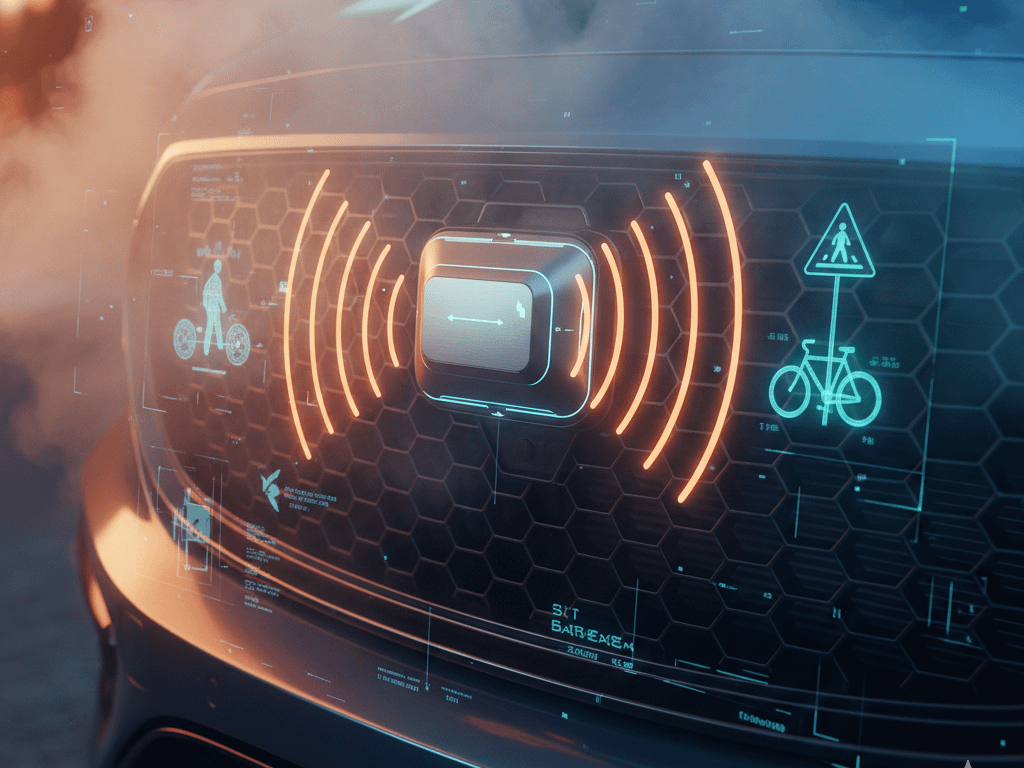
Introduction
By 2026, ADAS performance is largely determined by sensor precision + consistency + fusion, and the central compute (ECU/SoC) architecture that ingests raw data. Recent updates from CES and industry players show a decisive move toward low‑level (raw) sensor fusion in software‑defined vehicles. Key highlights include TI’s single‑chip 8×8 4D imaging radar and high‑performance ADAS SoCs, Omnivision’s HDR/LED‑flicker‑free cameras, expanding FMCW/solid‑state LiDAR programs (Valeo, Innoviz, Aeva), onsemi’s 7th‑gen ultrasonic, and Teradar’s THz long‑range sensor TI CES 2026, Omnivision × NVIDIA Hyperion, CES 2025 LiDAR recap, Teradar THz.
Seven Trends That Matter

- Imaging Radar at Scale
Single‑chip 4D imaging radar (AWR2188) measures range, azimuth, elevation, and Doppler simultaneously and remains robust in adverse weather. Front + corner radar proliferation targets ~300 m coverage for mainstream/premium segments TI CES 2026, ATZ electronics. - LiDAR: FMCW & Solid‑state
FMCW brings long‑range precision with inherent velocity measurement and better noise resilience. Costs are dropping; Valeo Scala 3, InnovizTwo, and Aeva Atlas Ultra are expanding into mid‑segment vehicles CES 2025 LiDAR recap. - Cameras: HDR + Flicker‑Free
8MP CMOS with HDR and LED‑flicker‑free tech stabilizes perception at night and under complex lighting. Integration with NVIDIA DRIVE Hyperion improves safety/security architecture readiness Omnivision EFY. - Ultrasonic: Near‑field & In‑cabin
onsemi’s 7th‑generation platform increases SNR and range, moving beyond parking aid to blind‑spot, rear cross traffic, occupant detection and even gesture control elec4 column. - Terahertz (THz) Emerges
THz aims to bridge the gap between radar and LiDAR with long‑range, high‑resolution and all‑weather capability. Teradar Summit demonstrated 300 m / 0.13° and targets 2028 production Interesting Engineering, WebProNews. - Cost‑effective Fusion (Camera + Radar)
Combining camera classification with radar’s precise range/velocity delivers robust L2+ functionality at mainstream costs Magna blog. - Shift to SDV Architectures
Raw sensor fusion handled by centralized ECUs/domain controllers is becoming the norm. See Aptiv’s Gen‑6 ADAS white paper and LeddarTech’s SDV/E‑E architecture perspective Aptiv Whitepaper, LeddarTech Whitepaper.
Pros & Cons by Sensor Type (Positioning Guide)
| Sensor | Strengths | Limitations/Risks | Typical Use | Leading Players |
|---|---|---|---|---|
| Radar (incl. imaging) | All‑weather robustness, direct Doppler, cost/reliability | Angular/elevation resolution historically lower vs. LiDAR/camera (imaging mitigates) | ACC, AEB assist, BSD, front/corner radar | TI AWR2188, NXP, Continental [1] |
| LiDAR (FMCW/solid‑state) | Long‑range high‑precision 3D, strong at night | Contamination/icing management, cost/packaging | L2+/L3 core perception | Valeo Scala 3, InnovizTwo, Aeva Atlas [2] |
| Camera (HDR/flicker‑free) | High‑res classification, lane/sign recognition, cost‑effective | Weather/back‑light sensitivity; needs fusion for distance | LKA/LFA, TSR, DMS/OMS | Omnivision × NVIDIA Hyperion [3] |
| Ultrasonic | Precise near‑field, low cost, expanding in‑cabin | Limited range; speed/classification constraints | Parking aid, RCTA, occupant detection | onsemi ultrasonic [4] |
| Terahertz (THz) | Long‑range + high‑res + all‑weather potential | Early ecosystem; cost/regulatory maturity pending | Forward long‑range (pilots) | Teradar Summit [5] |
Leading Companies & Notable Programs
- Texas Instruments: AWR2188 imaging radar + ADAS compute SoCs drive SDV‑ready platforms [TI].
- Valeo / Innoviz / Aeva: FMCW/solid‑state LiDAR programs expand beyond premium [CES Recap].
- Omnivision: HDR cameras integrated into NVIDIA Hyperion reference designs for robust low‑light performance [EFY].
- onsemi: 7th‑gen ultrasonic scaling to APS and occupant detection [elec4].
- Teradar: THz sensor (300 m / 0.13°) showcased; production targets 2028 [Interesting Engineering].
Market Sizes & Growth (Snapshot)
- ADAS sensors/components (broad): ~12% CAGR from 2025 to 2035 (camera, radar, LiDAR, ECUs) [FMI], [MarketGrowthReports].
- ECUs (sensor fusion/domain controllers): $12.88B (2025) → $35.75B (2033), 13.6% CAGR [LinkedIn MRI].
- Radar & camera spend (2024): Radar ~$7.2B, Camera ~$12.5B (component value) [MarketGrowthReports].
Deployment Checklist
- Align BOM to target level (L2+/L3): camera + radar for cost‑effective mainstream; add LiDAR for advanced stacks; pilot THz for long‑range robustness.
- Prefer low‑level/raw fusion to harden edge cases and weather sensitivity.
- Include de‑icing/defogging/cleaning for LiDAR & camera.
- Plan for OTA & cybersecurity (ISO 26262, UNECE R155/R156).
Conclusion
The path forward is multi‑sensor fusion + centralized compute + software‑defined architectures. Cameras and radar are ubiquitous, LiDAR is scaling fast, and THz is a promising next frontier. From 2026 to 2028, the winning play is balancing reliability vs. cost with robust fusion and SDV‑ready ECUs.
References
- TI CES 2026 newsroom: https://www.ti.com/about-ti/newsroom/news-releases/2026/2026-01-05-ti-accelerates-the-shift-toward-autonomous-vehicles-with-expanded-automotive-portfolio.html
- ATZ electronics (2024): https://link.springer.com/article/10.1007/s38314-024-1869-x
- Omnivision × NVIDIA Hyperion (2026): https://www.electronicsforu.com/news/building-vehicle-vision-for-adas-systems
- CES 2025 LiDAR recap: https://www.linkedin.com/pulse/post-ces-2025-report-lidar-automotive-technology-thakur-p-e–og6hc
- Teradar THz: https://interestingengineering.com/ces-2026/worlds-first-terahertz-vision-sensor
- Sensor fusion (camera + radar): https://www.magna.com/stories/blog/2025/unlocking-safer-driving-with-camera-and-radar-fusion-in-adas
- Aptiv Whitepaper (2024): https://www.aptiv.com/docs/default-source/white-papers/2024_aptiv_whitepaper_adasplatform_8-5x11_v10.pdf
- LeddarTech E/E Whitepaper (2024): https://leddartech.com/app/uploads/dlm_uploads/2024/01/White-Paper_ADAS-and-EE-Architecture-the-Frontiers-of-Software-Defined-Vehicles_V1.0_EN.pdf
- ADAS market / FMI (2025): https://www.futuremarketinsights.com/reports/adas-market
- ADAS component spend / MGR (2025): https://www.marketgrowthreports.com/market-reports/adas-and-autonomous-driving-components-market-106534
- ECU market / LinkedIn MRI (2026): https://www.linkedin.com/pulse/adas-ecu-market-intelligence-report-u5fmc/
++++++++++ KOREAN Version ++++++++++
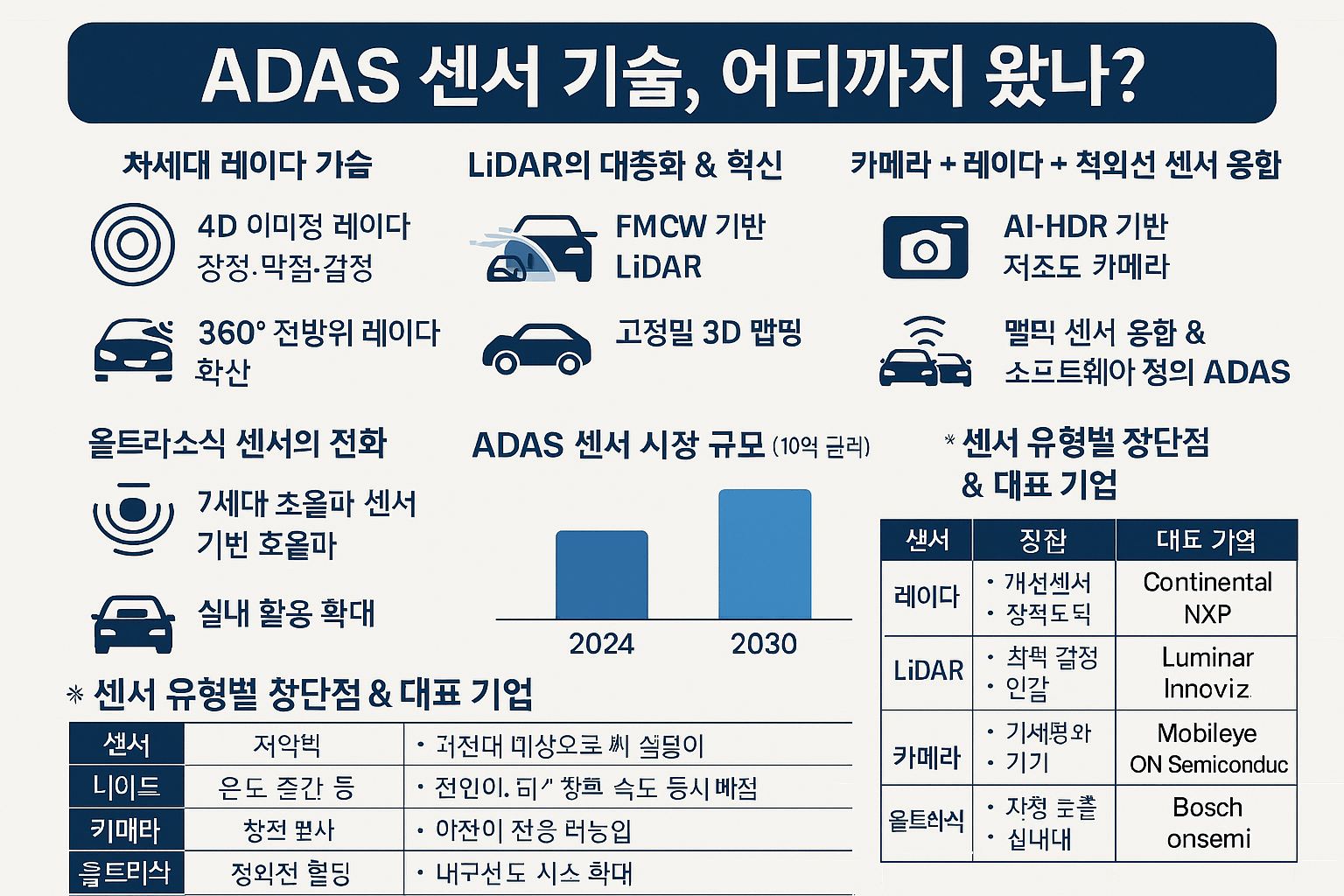
2026 ADAS 센서 기술, 어디까지 왔나? — 레이다·LiDAR·카메라·초음파·THz 트렌드
서론
2026년 현재, ADAS(첨단 운전자 보조 시스템)의 성능을 좌우하는 요소는 센서의 정밀도·일관성·융합력, 그리고 이를 뒷받침하는 중앙 컴퓨팅(ECU/SoC) 아키텍처입니다. CES 2026과 주요 산업 업데이트를 통해 레이다·LiDAR·카메라·초음파·테라헤르츠(THz)까지 멀티센서 원시(로우레벨) 융합이 표준으로 자리잡고 있음을 확인할 수 있습니다. 특히 TI의 8×8 4D 이미징 레이다와 고성능 ADAS SoC, Omnivision의 HDR 카메라, Valeo/Innoviz/Aeva의 LiDAR 개선, onsemi의 7세대 초음파, Teradar의 THz 센서가 주목됩니다 TI 2026 CES 발표, Omnivision × NVIDIA Hyperion, CES 2025 LiDAR 리포트, Teradar THz 센서.
핵심 트렌드 7가지
- 레이다(4D 이미징) 상용화 가속
단일 칩 4D 이미징 레이다(AWR2188)는 거리·방위각·고도·속도를 동시에 인지하며 악천후에서도 일관 성능을 제공합니다. 중·프리미엄 세그먼트에서 전방 및 코너 레이다 수량을 늘려 300m급 커버리지를 확보하는 추세입니다 TI 2026 CES, ATZ electronics 기사. - LiDAR의 FMCW/솔리드스테이트 혁신
FMCW 방식은 장거리·속도 동시 인지와 노이즈 강건성을 제공하며, 대량 생산으로 중형차까지 확산되고 있습니다. Valeo Scala 3, InnovizTwo, Aeva Atlas Ultra가 주목받습니다 CES 2025 LiDAR 리포트. - 카메라(HDR·LED 플리커 프리) 업그레이드
8MP급 HDR 센서가 LED 플리커를 제거하고 야간·역광 상황에서 안정적 인지 성능을 확보했습니다. NVIDIA DRIVE Hyperion과의 레퍼런스 통합으로 안전·보안이 강화됩니다 Omnivision 발표. - 초음파 센서의 실내·근거리 역할 확대
onsemi의 7세대 초음파는 SNR·감지 거리 개선으로 자동주차·후방 교차 감지뿐 아니라 탑승자 감지·제스처 인식까지 확대 적용되고 있습니다 elec4 기고. - 테라헤르츠(THz) 센서의 부상
THz 센서는 레이다와 라이다의 간극을 메우는 장거리·고해상·악천후 통합 성능을 제시했습니다. Teradar Summit은 300m/0.13° 사양을 시연하며 2028 양산 목표를 공개했습니다 Interesting Engineering, WebProNews. - 센서 융합(카메라+레이다)과 비용 최적화
카메라의 분류/인식 강점과 레이다의 거리/속도 강점을 결합하는 저비용·고효율 접근이 L2+ 대중화의 핵심으로 떠오릅니다 Magna 블로그. - SDV(소프트웨어 정의형 차량) 아키텍처로의 전환
원시 데이터 기반 저레벨 융합과 중앙 ECU/도메인 컨트롤러가 표준화됩니다. Aptiv의 6세대 ADAS 플랫폼과 LeddarTech의 E/E 아키텍처 화이트페이퍼가 방향성을 제시합니다 Aptiv Whitepaper, LeddarTech Whitepaper.
기술별 장단점 비교 (실무 포지셔닝 가이드)
| 센서 | 강점 | 한계/리스크 | 대표 적용 기능 | 대표 기업/제품 |
|---|---|---|---|---|
| 레이다 (이미징 포함) | 악천후 강건, 속도(Doppler) 직접 측정, 비용/신뢰성 우수 | 각도/고도 분해능은 LiDAR/카메라 대비 제한(이미징으로 개선 중) | ACC, AEB 보조, BSD, 코너/프런트 레이다 | TI AWR2188, NXP/Continental 모듈 [1] |
| LiDAR (FMCW/솔리드스테이트) | 장거리·고정밀 3D, 야간 강점 | 오염/결빙 관리 필요, 비용/패키징 민감 | L2+/L3 핵심 인지 | Valeo Scala3, InnovizTwo, Aeva Atlas [2] |
| 카메라 (HDR/플리커 프리) | 고해상 분류·차선·신호 인지, 비용 효율 | 악천후·역광 취약(융합으로 보완), 거리 추정 보조 필요 | LKA/LFA, TSR, DMS/OMS | Omnivision × NVIDIA Hyperion [3] |
| 초음파 | 근거리 정밀, 저비용, 실내 활용 확대 | 장거리 불가, 속도·분류 한계 | 자동주차, 후방교차, 탑승자 감지 | onsemi 초음파 플랫폼 [4] |
| 테라헤르츠(THz) | 장거리+고해상+악천후 통합 잠재 | 생태계 초기, 원가/규제 미성숙 | 장거리 전방 인지(파일럿) | Teradar Summit [5] |
대표기업·사례 스냅샷
- Texas Instruments: 8×8 4D 이미징 레이다(AWR2188)와 ADAS SoC로 SDV 구현 가속 [TI].
- Valeo/Innoviz/Aeva: FMCW·솔리드스테이트 LiDAR로 중형차까지 확산 [CES 2025 리포트].
- Omnivision: HDR 카메라 센서의 Hyperion 통합으로 야간·복잡 조명 안정성 강화 [EFY].
- onsemi: 7세대 초음파로 APS·탑승자 감지 등 영역 확대 [elec4].
- Teradar: THz 센서(300m/0.13°)로 악천후 통합 인지 제시, 2028 양산 목표 [Interesting Engineering].
시장 규모 & 성장률(요약)
- ADAS 센서·컴포넌트(광범위): 2025~2035년 CAGR 약 12%(카메라, 레이다, LiDAR, ECU 등) [FMI], [MarketGrowthReports].
- ECU(센서 융합/도메인 컨트롤러): 2025년 128억 달러 → 2033년 357억 달러, CAGR 13.6% [LinkedIn MRI].
- 레이다·카메라 지출: 2024년 레이다 약 72억 달러, 카메라 약 125억 달러(부품 지출 기준) [MarketGrowthReports].
실무 적용 체크리스트
- **목표 레벨(L2+/L3)**에 따라 센서 구성(BOM)을 설계: 카메라+레이다(대중화) / LiDAR 추가(고급) / THz 파일럿.
- 저레벨 융합(raw data) → 악천후·엣지 케이스 내성 강화.
- 오염/결빙 관리: 라이다·카메라 히터/세척 설계 포함.
- OTA·보안: SDV 아키텍처와 ECU 안전규격(ISO 26262, UNECE R155/156) 고려.
결론
ADAS 센서 기술의 방향성은 복합 센서 융합 + 중앙집중 컴퓨팅 + 소프트웨어 정의입니다. 대중화 단계의 카메라·레이다에 LiDAR가 빠르게 합류했고, THz는 차세대 대안으로 부상했습니다. 2026~2028년은 신뢰도와 비용의 균형을 잡는 실전 설계가 승부처가 될 것입니다.
작성자 소개


https://shorturl.fm/7hyrM
https://shorturl.fm/45Ibq
https://shorturl.fm/nalyK
https://shorturl.fm/TGho2
Claim Your Exclusive Bonus on AsterDEX https://is.gd/CGTnqR
Claim 5% Rebate and Exclusive Bonuses on AsterDEX https://is.gd/CGTnqR
Claim Your Exclusive Bonus on AsterDEX https://is.gd/CGTnqR
Claim Your Exclusive Bonus on AsterDEX https://is.gd/CGTnqR
Hello https://is.gd/tvHMGJ
Boost your profits with our affiliate program—apply today!
Promote our brand and watch your income grow—join today!
Join our affiliate community and start earning instantly!
Become our partner and turn referrals into revenue—join now!
Unlock top-tier commissions—become our affiliate partner now!
Tap into unlimited earnings—sign up for our affiliate program!
Promote our brand and get paid—enroll in our affiliate program!
Promote, refer, earn—join our affiliate program now!
Get started instantly—earn on every referral you make!
Invite your network, boost your income—sign up for our affiliate program now!
Join our affiliate community and start earning instantly!
Share your unique link and earn up to 40% commission!
Unlock exclusive rewards with every referral—apply to our affiliate program now!
Monetize your traffic instantly—enroll in our affiliate network!
Share your unique link and cash in—join now!
Share our products, reap the rewards—apply to our affiliate program!
Turn your network into income—apply to our affiliate program!